
Oct . 24, 2025 09:45 Back to list
West Nile virus detection: rapid PCR kits & lab solutions
west nile virus detection is a key solution in the healthcare industry, specifically within in vitro diagnosis and Molecular Diagnostics. This article explores how Taizhou Cowingene Biotech Co.,Ltd. supports professionals with durable, high-performance products, and explains why this product is an ideal choice for businesses in these sectors.
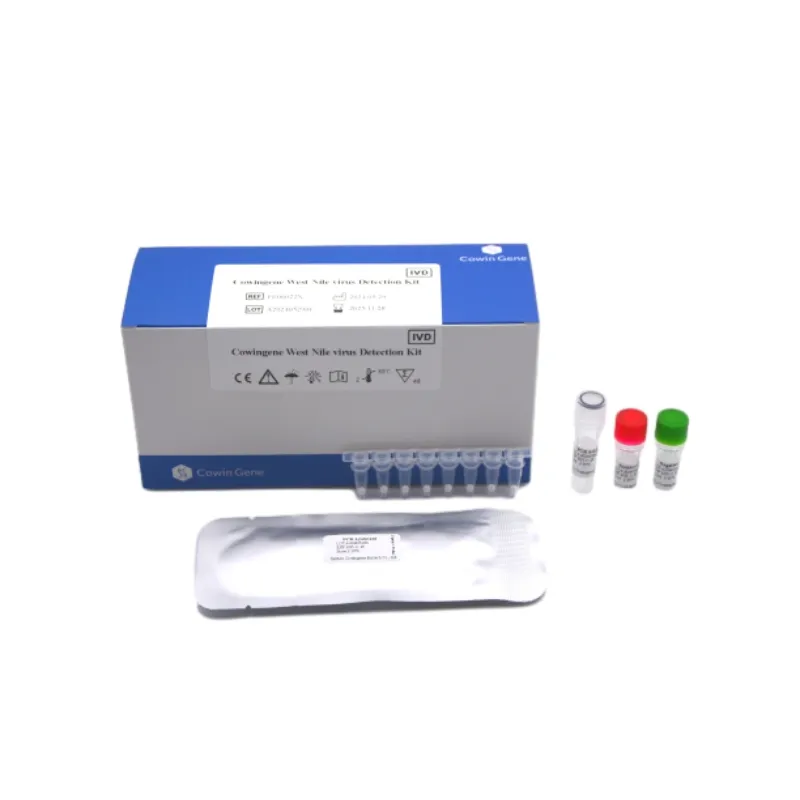
Table of Contents
- west nile virus detection Overview
- Benefits & Use Cases of west nile virus detection in Molecular Diagnostics
- Cost, Maintenance & User Experience
- Sustainability & Market Trends in healthcare
- Conclusion on west nile virus detection from Taizhou Cowingene Biotech Co.,Ltd.
west nile virus detection Overview
West Nile virus (WNV) is a mosquito-borne flavivirus that requires fast and reliable molecular screening to inform clinical decisions and public health response. In modern in vitro diagnosis workflows, west nile virus detection is commonly performed using real-time RT-PCR (often referred to as west nile virus PCR), which targets conserved genomic regions and delivers high analytical sensitivity and specificity. For B2B buyers—reference labs, hospital systems, and public health agencies—the priority is a robust assay that integrates seamlessly with existing extraction platforms and real-time PCR instruments while supporting multi-matrix testing (e.g., serum, plasma, CSF, and vector surveillance samples).
Taizhou Cowingene Biotech Co.,Ltd. provides a purpose-built west nile detection solution engineered for high performance and operational simplicity. The kit is designed for real-time RT-PCR workflows, includes appropriate controls to monitor extraction and amplification, and is compatible with mainstream qPCR cyclers used across Molecular Diagnostics labs. Whether used during seasonal surges or for routine surveillance, Cowingene’s approach focuses on reproducibility, clear result interpretation, and dependable lot-to-lot consistency—key factors for labs that must scale without compromising quality. A technical support team and in-depth documentation further streamline validation and onboarding.
Benefits & Use Cases of west nile virus detection in Molecular Diagnostics
In Molecular Diagnostics, west nile virus detection supports multiple use cases: patient testing in acute care settings, donor screening workflows in transfusion networks, and vector-borne disease surveillance by public health laboratories. Real-time RT-PCR yields timely results that help clinicians manage suspected neuroinvasive disease and guide infection control. For centralized labs, a standardized west nile virus PCR protocol enables predictable throughput and efficient reagent planning. For decentralized settings, streamlined reaction setup and clear result reporting reduce training burden and support consistent outcomes across sites.
Taizhou Cowingene Biotech Co.,Ltd. differentiates with features that matter to operations leaders: workflow-friendly reagent design, strong analytical performance, and compatibility with existing liquid-handling and thermocycler fleets. The kit’s internal control helps flag inhibition or extraction issues early, reducing repeat runs and protecting turnaround time during peak mosquito seasons. With responsive technical support and documentation tailored for validation teams, Cowingene helps institutions accelerate go-live while maintaining rigorous quality standards—delivering a practical edge over generic west nile detection offerings.
Cost, Maintenance & User Experience
Total cost of ownership for west nile virus detection hinges on more than list price. Labs seek predictable supply, stable shelf life, low hands-on time, and minimal repeat testing. Cowingene’s kit is designed to fit into existing extraction and qPCR infrastructures—helping avoid new capital expenditures—while the workflow-focused format can reduce pipetting steps and technician time. Built-in controls help minimize invalids, protecting throughput and supporting a strong ROI across outbreak and off-season periods.
Operational users in the in vitro diagnosis sector value straightforward protocols, concise IFUs, and readable amplification curves for rapid interpretation. Procurement teams appreciate transparent lead times and scalable supply planning. While each lab’s experience varies by instrument and sample mix, decision makers commonly report that aligning on a standardized west nile virus PCR method improves scheduling, reduces training overhead, and supports sustained capacity planning—key for networked labs managing seasonal vector-borne testing spikes.
Sustainability & Market Trends in healthcare
Vector-borne diseases are expanding as climate and mobility patterns shift, driving sustained demand for rapid surveillance and confirmatory testing. Regulatory expectations emphasize quality systems, traceability, and risk management throughout the product lifecycle. Buyers increasingly favor vendors that support responsible sourcing, optimized shipping, and efficient packaging to reduce waste across the diagnostics supply chain, while maintaining robust quality documentation for procurement and audits.
Taizhou Cowingene Biotech Co.,Ltd. positions itself as a forward-thinking partner by focusing on durable, workflow-efficient reagents and by aligning operations with rigorous quality practices. For B2B decision makers, this means a supplier mindful of both clinical impact and operational sustainability—supporting long-term resilience in west nile detection programs. As health systems expand molecular capacity and integrate data-driven surveillance, Cowingene’s emphasis on reliability, scalability, and service readiness matches the direction of the global Molecular Diagnostics market.
Conclusion on west nile virus detection from Taizhou Cowingene Biotech Co.,Ltd.
Effective west nile virus detection underpins timely clinical care and public health action. For Molecular Diagnostics laboratories, Cowingene’s practical, high-performance approach to west nile virus PCR offers operational ease, dependable results, and the scalability needed for seasonal surges. Taizhou Cowingene Biotech Co.,Ltd. is a reliable partner for teams seeking quality, consistency, and responsive support across diverse testing environments.
- Contact us: email: info@cowingene.com
- Visit our website: https://www.cowingene.com
- Explore the product: https://www.cowingene.com/cowingene-west-nile-virus-detection-kit.html
Related PRODUCTS
-
Rapid HPV 16/18/45 Molecular Detection with NATBox for Targeted Cervical Cancer Screening
NewsApr.24,2026 -
High-Sensitivity HPV (2+16) Molecular Detection for Early Cervical Cancer Screening
NewsApr.24,2026 -
Comprehensive HPV 28 Genotyping Solution for Advanced Cervical Cancer Screening
NewsApr.24,2026 -
Comprehensive HPV 15 Genotyping Solution for Accurate Cervical Cancer Risk Assessment
NewsApr.24,2026 -
Comprehensive 14-Pathogen STI Detection Solution for Accurate Molecular Diagnosis
NewsApr.24,2026 -
Accurate and Reliable HSV-1/2 Molecular Detection for Clinical Diagnosis
NewsApr.24,2026